

Real-World Inspirations for Berries of Betrayal: Delaware’s Path to Righteous Reform
This page provides the real-world sources and context that inspired the events in Berries of Betrayal. The story is a fictionalized allegory drawing from public events, not a direct retelling. All references are publicly available news articles and records.
Thank you for reading Berries of Betrayal: Delaware’s Path to Righteous reform.
Delaware auditor dodges felony charges, guilty of misconduct
WHYYhttps://whyy.org/articles/delaware-auditor-dodges-felony-charges-guilty-misconduct
In July 2022, Delaware State Auditor Kathy McGuinness (a Democrat elected in 2018 and the first statewide elected official prosecuted while in office) was acquitted of felony charges of theft and witness intimidation, but convicted of three misdemeanors: conflict of interest, official misconduct, and structuring contracts to evade procurement rules. The convictions stemmed from hiring her daughter amid staff shortages in 2020, issuing payments under a no-bid contract with a campaign firm to stay below approval thresholds, and related office practices that prosecutors argued abused her position.Delaware auditor who resigned after 2022 corruption conviction seeks a political comeback
WHYYhttps://whyy.org/articles/kathy-mcguiness-runs-state-representative-delaware
In May 2024, former Delaware State Auditor Kathy McGuinness (a Democrat who resigned in October 2022 after her 2022 misdemeanor convictions and was the first statewide elected official prosecuted while in office) announced her bid for the Democratic nomination to the Delaware House of Representatives in District 14 (Rehoboth Beach area), vacated by retiring Speaker Pete Schwartzkopf, who endorsed her. The article details her background as a former Rehoboth Beach commissioner, her 2022 convictions (conflict of interest for hiring her daughter remotely while in college, official misconduct, and initially structuring contracts—though some were later adjusted), her probation/fine/community service sentence, and the challenges of her comeback amid ethical concerns from opponents in the three-way primary.Delaware Beer Distributor: I Wore a Wire to Probe Biden’s Fundraising
POLITICOhttps://www.politico.com/news/magazine/2020/07/21/christopher-tigani-joe-biden-fundraising-373724
In July 2020, Politico reported that Christopher Tigani, a prominent Delaware beer distributor with longstanding family and social ties to Joe Biden, admitted to illegally bundling and reimbursing employee donations (straw donor scheme) totaling around $72,000 for Biden's 2008 presidential campaign. After being confronted by the FBI in September 2010, Tigani pleaded guilty in 2011 to campaign finance violations and cooperated as an informant by wearing a wire in 2011 to record conversations with individuals close to Biden (including former finance chief Dennis Toner and others) in an attempt to uncover potential quid pro quo or knowledge of the illegal reimbursements; however, federal investigators ultimately deemed his information "not actionable," leading to no charges against politicians, and Tigani was sentenced to two years in federal prison in 2012.Former Delaware Public Officer Pleads Guilty in $3M Federal Bribery Case
U.S. DEPARTMENT OF JUSTICE
https://www.justice.gov/usao-de/pr/former-delaware-public-officer-pleads-guilty-3m-federal-bribery-case
On April 17, 2019, a former Delaware public officer (identified in related DOJ announcements as Crystal Martin, former Associate Registrar at Delaware State University, a public institution) pleaded guilty in federal court to charges related to a bribery scheme involving approximately $3 million in federal funds. The case centered on abusing her position at the university to personally profit and defraud her employer through corrupt practices tied to programs receiving federal funds (with U.S. Attorney David C. Weiss stating the defendant "abused her position at a public university to personally profit and to defraud her employer"); she was later sentenced to 15 months' incarceration in February 2020.Accountability and Transparency are Essential for Trust
A damning special inquiry reveals fiscal failures in one of Delaware’s fastest-growing districts
SCHOOLING DELAWAREhttps://schoolingdelaware.com/p/accountability-and-transparency-are
A September 2025 special inquiry report by Delaware State Auditor Lydia York into the Appoquinimink School District—one of the state's fastest-growing districts—revealed significant fiscal failures, including repeated budgeting errors, understated expenses, incomplete financial reports, and large deficits over several years, culminating in a $4.9 million shortfall announced in July 2025 and a 10% tax increase that surprised residents and eroded public trust. The piece from Schooling Delaware highlights a pattern of incompetence in budgeting, reporting, and governance by Superintendent Dr. Matt Burrows and the CFO, lack of standardized processes, and calls for accountability measures like internal controls, staff training, timely disclosures, and broader statewide examination to prevent similar crises.
Special inquiry finds Appoquinimink School District budgeting failures led to $4.9 million deficit
DELAWARE PUBLIC MEDIAhttps://www.delawarepublic.org/education/2025-09-03/special-inquiry-finds-appoquinimink-school-district-budgeting-failures-led-to-4-9-million-deficit
On September 3, 2025, Delaware State Auditor Lydia York's special inquiry report revealed that budgeting, reporting, and review failures in the Appoquinimink School District—one of Delaware's fastest-growing districts—led to a $4.9 million budget shortfall announced in July 2025, prompting a surprise 10% property tax increase that blindsided residents and damaged public trust. The inquiry highlighted issues like lack of policy compliance, insufficient management oversight (including by Superintendent Matthew Burrows and the CFO), no segregation of duties in financial reporting, underestimated expenses over multiple years, and missed opportunities for stronger governance, with recommendations for better practices, training, and statewide improvements to prevent similar crises (no evidence of fraud or malice was found).Delaware school district policy allows hiding transgender identities from parents
RED LIONhttps://readlion.com/delaware-school-district-policy-allows-hiding-transgender-identities-from-parents
In a December 2024 article, The Lion reported that Red Clay Consolidated School District's Policy 8005 (adopted in December 2021) allows transgender and gender diverse students to express their gender identity at school—including using preferred names/pronouns, facilities like restrooms/locker rooms/sports aligned with their asserted gender, and social transitioning—while permitting school personnel to withhold this information from parents unless the student or parent authorizes disclosure. The policy states that when contacting parents, staff should use the student's legal name and pronouns corresponding to their sex assigned at birth "unless the student, parent, or guardian has specified otherwise," framing this as protecting student privacy and allowing students to decide "when, with whom, and how much to share private information" about their gender identity; the article highlights concerns that this enables schools to "hide" transgender identities from parents without requiring notification or consent.List of School District Transgender – Gender Nonconforming Student Policies
DEFENDING EDUCATIONhttps://defendinged.org/investigations/list-of-school-district-transgender-gender-nonconforming-student-policies
Defending Education (a parental rights organization) maintains a national compilation of over 1,200 U.S. school district policies on transgender and gender nonconforming students, claiming many explicitly allow or direct school personnel to keep a student's gender identity or transgender status confidential from parents without requiring notification or consent. The list includes Delaware districts such as Red Clay Consolidated (Policy 8005) and Christina School District (Policy 02.27), where policies emphasize student privacy in deciding when and how to share gender identity information, allow social transitioning (e.g., preferred names/pronouns, facility use), and instruct staff to use legal name/pronouns matching birth sex only unless the student or parent specifies otherwise; the page provides links to individual policy documents and invites reports of additional districts.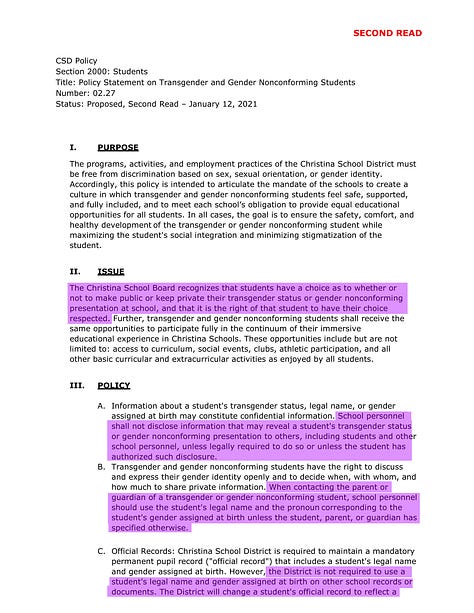
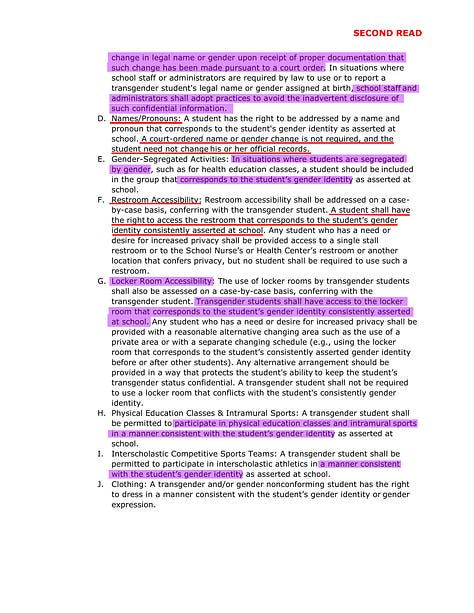
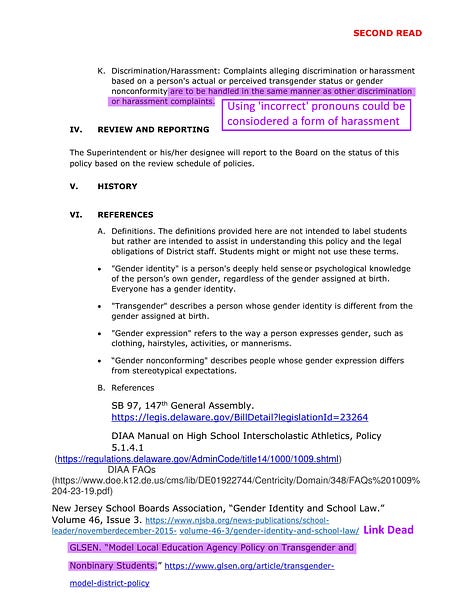
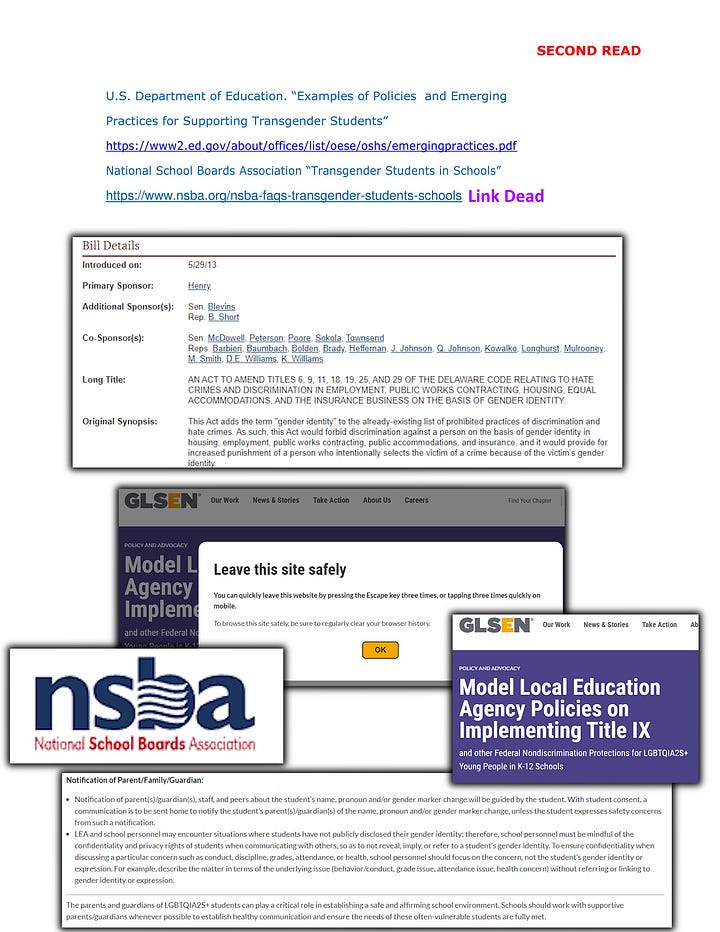
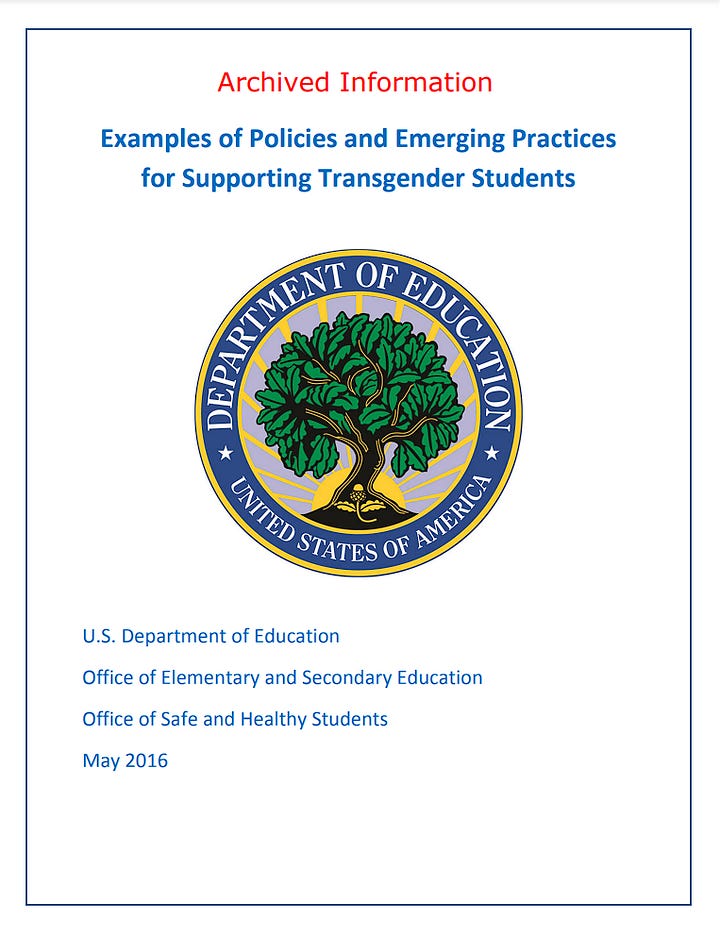
Christina school district's "Transgender & Gender Nonconforming Student" policy which requires the school to KEEP SECRETS FROM PARENTS!!! 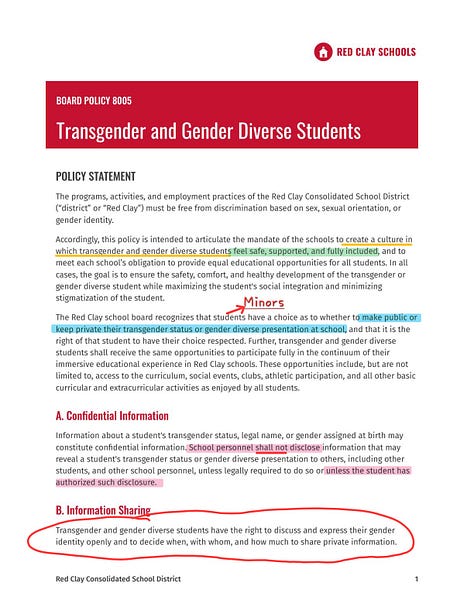
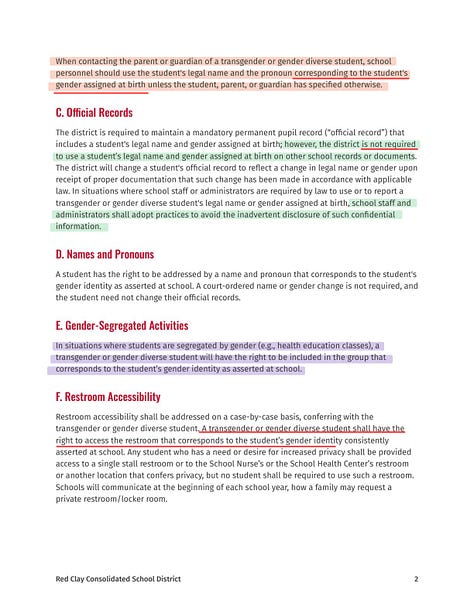
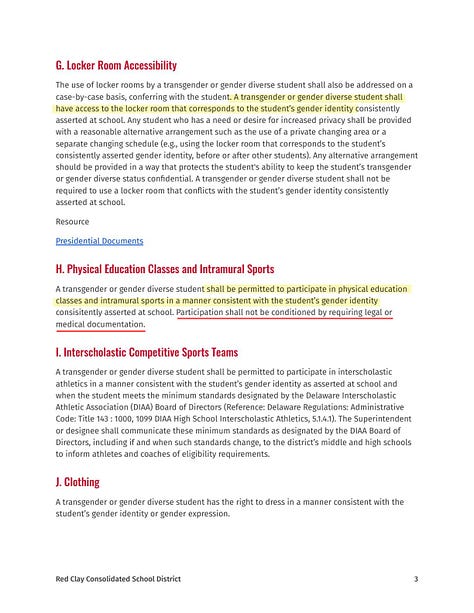
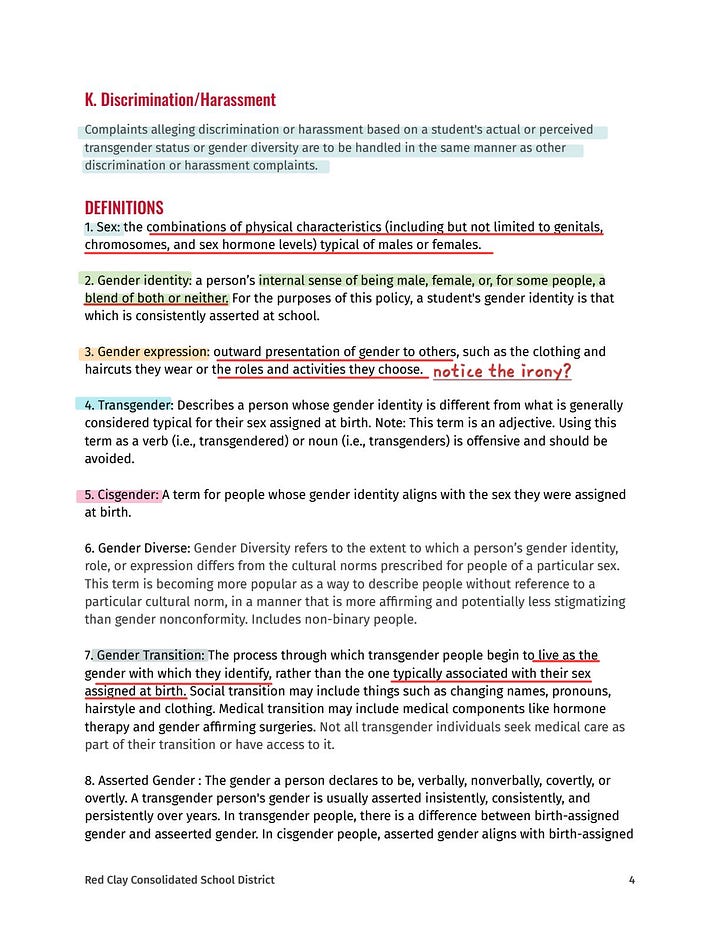
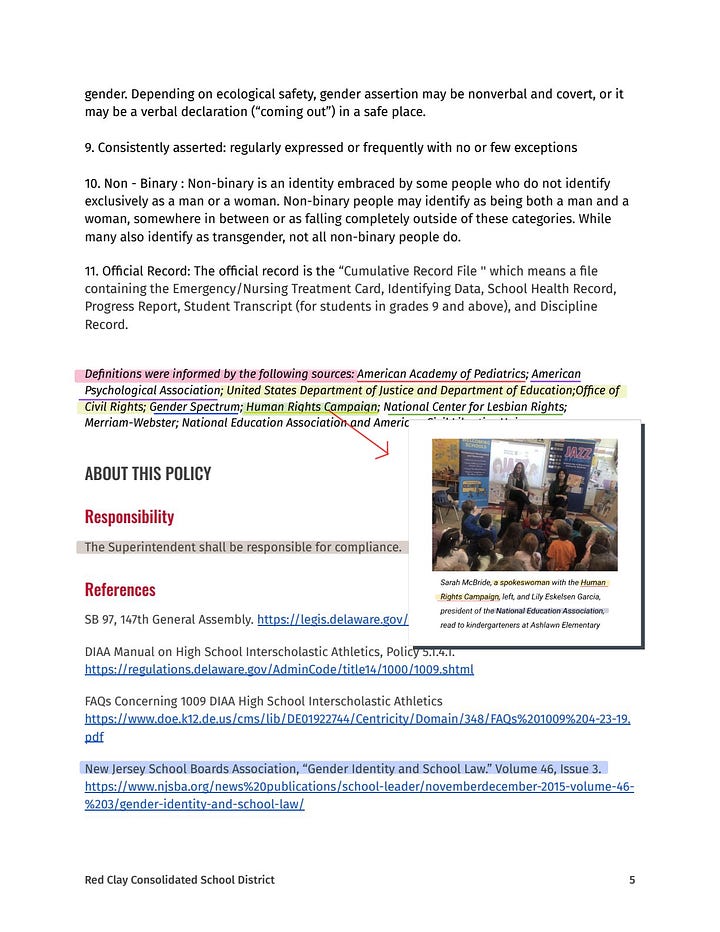
Red Clay school District's "Policy 8005 Transgender and Gender Diverse Students" policy which requires the school to KEEP SECRETS FROM PARENTS!!! Former Dover Interfaith Mission for Housing Employees Plead Guilty to Stealing Federal Funds
U.S. DEPARTMENT OF JUSTICEhttps://www.justice.gov/usao-de/pr/former-dover-interfaith-mission-housing-employees-plead-guilty-stealing-federal-funds
On August 11, 2025, the U.S. Attorney's Office for the District of Delaware announced that Karen D. Wilder (39, former Executive Director) and her husband Renwick L. Davis (49, former Case Manager) of the Dover Interfaith Mission for Housing (DIMH), a nonprofit providing services to homeless individuals in Delaware, pleaded guilty to theft of public funds for collectively embezzling approximately $600,000 from the organization's bank accounts between December 2021 and November 2023. The stolen funds included federal grant money from the U.S. Department of Housing and Urban Development (HUD) and the U.S. Department of the Treasury intended for emergency housing assistance, critical medical support during the COVID-19 pandemic, and other services for those homeless or at risk; the scheme involved various fraudulent methods to divert the money.(Note: Subsequent reports indicate Wilder was sentenced in January 2026 to 2.5 years in prison and full restitution, while Davis received probation and partial restitution, but this summary focuses on the original plea announcement from the linked DOJ press release to align with its timing and content.)
Former Dover Interfaith Mission employees admit embezzling federal funds meant for homeless services
THE FEDERAL NEWSWIREhttps://thefederalnewswire.com/stories/674333482-former-dover-interfaith-mission-employees-admit-embezzling-federal-funds-meant-for-homeless-services
Karen D. Wilder (39, former Executive Director) and Renwick L. Davis (49, former Case Manager and her husband) of the Dover Interfaith Mission for Housing (DIMH)—a Delaware nonprofit providing services to homeless individuals—pleaded guilty on August 8, 2025, to theft of public funds for collectively embezzling approximately $600,000 in federal grants from the U.S. Department of Housing and Urban Development (HUD) and the U.S. Department of the Treasury between December 2021 and November 2023. The funds were intended for emergency housing assistance, critical support during the COVID-19 pandemic, and other services for those homeless or at risk; the scheme involved fraudulent methods such as Wilder withdrawing cash under false pretenses for "emergency aid," depositing it personally, and transferring about $150,000 to Davis's account purportedly for rental/mortgage help, which was instead spent on luxury goods, shopping, travel, and personal expenses like Wilder's mortgage (U.S. Attorney Julianne E. Murray noted the defendants "abused the trust of their positions and stole taxpayer dollars intended to provide essential services to Delaware’s most vulnerable citizens").Dr. Earl Bradley Accused of Abuse Two Years Before Molestation of Hundreds Began
ABC NEWShttps://abcnews.go.com/US/TheLaw/hospital-overlook-pediatrician-earl-bradley-abuse-allegations/story?id=10415082
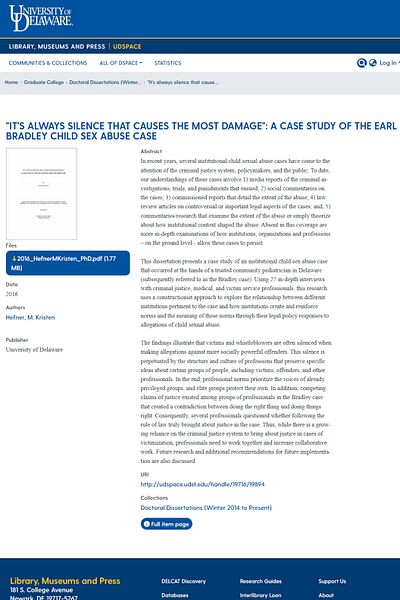
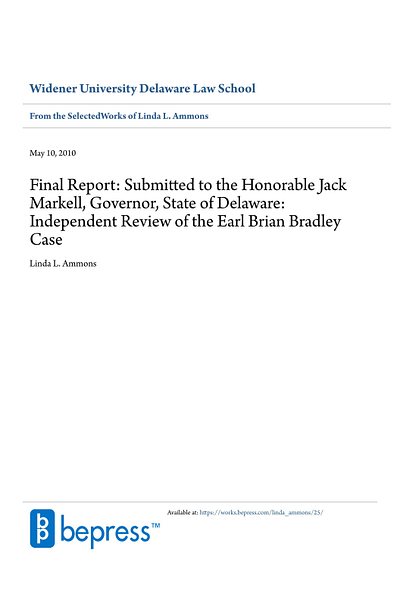
In a December 2009 ABC News report (updated April 2010), Beebe Medical Center disclosed that a nurse had complained in 1996 that Dr. Earl Bradley may have been inappropriately touching young female patients during urine sample examinations; the hospital conducted an internal peer review that cleared him as within standard medical practices and did not report it to the Delaware Board of Medical Practice. This early red flag occurred roughly two years before the alleged start of his large-scale molestation spree in 1998, which led to his December 2009 arrest and February 2010 indictment on 471 counts of sexual abuse involving over 100 child patients (mostly girls, some as young as infants), including videotaped acts and repeated abuse over months or years.Prestige protects even the worst abusers
ATLANTA JOURNAL-CONSTITUTIONhttps://doctors.ajc.com/why_abusive_doctors_not_caught
In this 2016 investigative piece (part of the AJC's broader "Doctors & Sex Abuse" series), the Atlanta Journal-Constitution details how prestige and a culture of self-policing in the medical profession shield even the most egregious abusers, exemplified by Delaware pediatrician Dr. Earl Bradley, who molested or assaulted at least 1,200 child patients (mostly young girls, some infants) over 15 years starting around 1994, recording hours of video evidence, before his 2009 arrest and 2011 life sentence without parole. The article highlights systemic failures: multiple prior complaints (e.g., a 1994 incident where Bradley blamed the mother and avoided charges, a 1996 nurse report cleared internally by Beebe Medical Center without reporting to regulators, and eight unpunished accusations from 1994–2008), confidential peer reviews that dismissed misconduct, deference to doctors over victims, and reluctance by medical boards to impose harsh discipline, allowing Bradley to continue practicing despite red flags—all illustrating how professional prestige prioritizes rehabilitation and secrecy over patient protection and accountability.A decade after Bradley abuse case, survivors still seek help
SPOTLIGHT DELAWAREhttps://spotlightdelaware.org/2025/11/13/a-decade-after-bradley-abuse-case-survivors-still-seek-help
In a November 13, 2025, investigative report (updated November 16), Spotlight Delaware examines the lasting impact on survivors of Dr. Earl Bradley's abuse—where the Lewes pediatrician sexually assaulted hundreds of infants and young children (over 1,000 victims identified, many videotaped) from the mid-1990s until his 2009 arrest—leading to his 2011 conviction and 14 life sentences. A landmark $123 million class-action settlement in 2012 provided payouts to about 980 participating families based on abuse severity (with $32 million to lawyers), but many survivors now face delayed trauma (e.g., PTSD, substance issues) emerging in adulthood, and a $3 million Latent Injury Trust Fund has denied claims due to strict medical verification requirements, leaving some with only limited aid like $25,000 from Delaware's Victims’ Compensation Assistance Program for therapy. The article highlights ongoing needs for better mental health support, therapy access, and community resources, criticisms of the trust's administration and inconsistent eligibility, sealed court records limiting transparency, and calls for improved follow-through to address resurfacing trauma among survivors.Corruption Runs Deep in Delaware Land Deal
COASTAL NETWORKhttps://coastalnetwork.com/corruption-runs-deep-in-delaware-land-deal
In a December 30, 2020, article, Coastal Network alleges that under Governor John Carney's administration, the state of Delaware sold 11 acres of public land (originally purchased for $2.78 million in 2008 during the economic downturn) to political insider John Paradee—a major Carney supporter, fundraiser, and brother of State Senator Trey Paradee and Jackie Paradee Mette (Carney's legal counsel and former 2016 campaign finance director)—for just $275,000 in 2018, resulting in a claimed taxpayer loss of $2.525 million. The sale allegedly violated procedures (citing Title 17, Chapter 1, Section 137(b)(3) requirements for public auctions, notice, and sales at no less than 85% of appraisal value), lacked transparency per Freedom of Information Act records, involved no public auction or notice, and occurred despite the land's commercial development potential (per a Delaware Department of Transportation evaluation noting it met only two of five "minimal independent utility" criteria); six months later, Senator Trey Paradee sponsored and passed a lodging tax increase (from 8% to 11%) benefiting a related Turf Sports Complex project (where John Paradee served on the board), after which the 11 acres plus adjacent 10 acres were marketed together for $6.5 million.DelDOT investigating land deal struck with a chief planner’s business partner
SPOTLIGHT DELAWAREhttps://spotlightdelaware.org/2025/11/10/deldot-investigating-land-deal-struck-with-a-chief-planners-business-partner
In November 2025, Spotlight Delaware reported that the Delaware Department of Transportation (DelDOT) launched an internal investigation—prompted by the outlet's inquiry—into its 2023 purchase of land near Route 1 for $1.6 million as part of a Route 1 improvement project, after the property was sold by an LLC owned by businessman [name implied as Messina from context] who had purchased it about eight years earlier for around $200,000–$230,000, yielding roughly a seven-fold profit (approximately $1.4 million gain). The deal raised questions about potential conflicts of interest because the seller's business partner is Todd Sammons, a chief planner at DelDOT; DelDOT spokesman C.R. McLeod confirmed the probe into "claims of a business relationship influencing a property acquisition" was ongoing, with no public results disclosed by late 2025 (the article notes the land was cleared/demolished post-purchase, and the investigation stems from concerns over safeguards against personal business interests interfering in public acquisitions).Trey Paradee— “I was not aware”
FIGHT DE CORRUPTIONhttps://www.fightdecorruption.com/paradee
The FightDECorruption.com page (a site advocating for ethics reform and transparency in Delaware government) alleges potential conflicts of interest involving Delaware State Senator Trey Paradee (D-Dover) in sponsoring Senate Bill 178 (SB 178) in June 2019, which authorized Kent County to impose a lodging tax (up to 3%) with revenue directed solely to the nonprofit DE Turf sports complex near Frederica. The site claims this benefited Trey's brother John Paradee (a land-use attorney who sat on the DE Turf board and had investments in the adjacent Asbury Square development, a 21-acre project marketed for hotels/restaurants tied to DE Turf's success), potentially creating financial gains through increased property value and economic activity from the tax (estimated at nearly $1 million annually for DE Turf). Trey Paradee has repeatedly denied awareness or involvement, stating in 2019 (per his op-ed and News Journal reports): “I was not aware that he was a member of the DE Turf’s volunteer board…” and emphasizing that he and his brother rarely discuss work due to separate careers and lives; he described learning of John's DE Turf role incidentally and vowed to seek repeal or modification of the tax authority in subsequent sessions (after a News Journal investigation in late 2019 prompted John to resign from the board). The page also references a similar "I was not aware" response from Trey in a 2014 News Journal article about the brothers advocating for a highway interchange benefiting DE Turf and Asbury Square, framing it as a pattern of claimed ignorance amid family-linked development projects.Caesar Rodney schools wanted to buy a $10M property — from a school board member
SPOTLIGHT DELAWAREhttps://spotlightdelaware.org/2025/10/19/caesar-rodney-schools-wanted-to-buy-a-10m-property-from-a-school-board-member
In October 2025, Spotlight Delaware reported that the Caesar Rodney School District sought state approval in August 2025 to purchase a 207-acre property near Camden (adjacent to Postlethwait Middle School on South State Street) for $9.6 million (nearly $10 million) from its own board vice president, David Failing, to expand and replace the Charlton School (which serves students with disabilities from kindergarten through adulthood). Failing had purchased the full 207-acre rural plot for $11 million in summer 2024 from Beiser Group LLC after prior district discussions (including confidential executive sessions), intending to sell it to the district at a $1 million loss to secure it before developers could build homes there and worsen overcrowding; the district initially requested a smaller 43-acre portion for $2.2 million (rejected), then the full parcel, with Failing not abstaining from the board vote to submit the request despite the disclosed ownership in the certificate of necessity. The Delaware Department of Education rejected the August submissions on October 17, 2025, due to capital budget limitations, halting the deal (though the district may revise and resubmit in the future, as the need persists); no public disclosure of Failing's ownership occurred during meetings, raising transparency and conflict-of-interest concerns (e.g., potential recusal requirements under Delaware ethics rules, though Failing noted he is not a state employee and called such arrangements "not unusual" in Kent County). Superintendent Corey Miklus described the district as "lucky" that Failing bought the land to prevent development, while board president Jessica Marelli indicated likely future resubmission.Suspicious payments and dirty tricks: Will husband’s controversies impact Lt. Gov. Bethany Hall-Long’s bid for governor?
WHYYhttps://whyy.org/articles/bethany-hall-long-husband-controversies-delaware-governor-campaign-2024
In this December 21, 2023, WHYY article, reporter Cris Barrish examines potential vulnerabilities in then-Lt. Gov. Bethany Hall-Long's 2024 Democratic gubernatorial campaign stemming from controversies involving her husband, Dana Long, particularly around campaign finance practices and past allegations of "dirty tricks." Key issues include: Dana Long (who served as his wife's campaign treasurer) writing checks to himself from campaign accounts totaling around $207,000 (later expanded in follow-up reports to nearly $300,000 across 2016–2023 cycles), with questions about whether these were properly disclosed as reimbursements for loans/advances or constituted improper personal payments; suspicions of "suspicious payments" and lack of transparency in reporting; and earlier claims of political "dirty tricks" (e.g., anonymous or misleading tactics in past races). Hall-Long dismissed these as old, irrelevant distractions from her record and qualifications, stating the issues had been addressed or were minor, while opponents and critics (including in the Democratic primary) used them to question her ethics and management. The piece notes no formal charges or major investigations at the time of writing but highlights how such family-linked controversies could erode voter trust in a competitive race focused on transparency and reform.(Note: Later developments—such as a July 2024 Delaware Department of Elections forensic audit—found repeated violations of state law, including failure to disclose about $298,000 in payments to Dana Long and improper loan recording, leading to required amendments, public criticism, calls for her to drop out, and no prosecution due to narrow law interpretations. Hall-Long continued her bid, fired her husband as treasurer, and defended the errors as unintentional carelessness. The original 2023 article sets the stage for these amplified concerns.)
New Castle County Councilmembers call for independent audit of property reassessment
DELAWARE LIVEhttps://delawarelive.com/ncc-councilmembers-call-for-audit-reassessment
On July 30, 2025, New Castle County Councilmembers David Tackett and Brandon Toole called for an independent audit of the county's recent countywide property reassessment (the first in decades, conducted by Tyler Technologies), citing widespread resident concerns over lack of transparency in methodology, inconsistent valuations (e.g., similar properties assessed differently within neighborhoods, while some high-value commercial properties saw decreases), a flawed appeals process with many denials or only minor adjustments, disproportionate shifts in tax burden onto residential properties (impacting vulnerable groups like seniors and low-income families), and overall erosion of public trust. Tackett noted that “many residents feel that the methodology used by Tyler Technologies lacks transparency, and the appeals process has not adequately addressed their concerns,” while Toole emphasized the need to investigate the “significant shift in the tax burden on residential properties”; no immediate response from county officials was detailed in the article, and the call aimed to restore confidence through external review.Henry: Gov. Meyer delayed reassessment data until after election
SPOTLIGHT DELAWAREhttps://spotlightdelaware.org/2025/09/30/henry-gov-meyer-delayed-reassessment-release-until-after-election
In a September 30, 2025, legislative committee hearing on Delaware's property reassessment process, New Castle County Executive Marcus Henry testified that then-County Executive (now-Governor) Matt Meyer delayed the release of tentative property value notices until mid-November 2024—after the November 2024 gubernatorial election—despite repeated recommendations from the county's assessment team and contractor Tyler Technologies to send them out in summer 2024. Henry stated it was his understanding that "the former Administration said no to those recommendations" and "the assessment office was advised that tentative value notices couldn’t go out until mid-November," amid a heated Democratic primary between Meyer and Bethany Hall-Long; the delay has fueled accusations of political motivation to avoid voter backlash over potential tax increases during the campaign, contributing to broader criticisms of transparency in the first countywide reassessment in decades (prompted by a 2020 lawsuit).(Note: Gov. Meyer later denied the claims, with his office refuting any deliberate delay for political reasons, as reported in follow-up coverage; the article focuses on Henry's testimony and its implications for public trust in the reassessment rollout.)
Citizen Initiative Property Tax Town Hall
August 7, 2025 With Reps. Mike Smith & Kevin Hensley

On August 7, 2025, State Representatives Mike Smith (R-Pike Creek Valley) and Kevin Hensley (R-Townsend/Odessa/Port Penn) participated in a public town hall at Millcreek Chambers Hall to address widespread resident concerns over New Castle County’s 2025 property reassessment and resulting tax increases. The event focused on citizen-driven initiatives for property tax reform, transparency in valuation processes, fair appeals, and limits on tax hikes, amid criticisms of flawed methodologies, inconsistent assessments, and eroded public trust—serving as a key forum for discussion ahead of the General Assembly’s August 12 special session that passed emergency relief measures.
Delaware Court Strikes Down Musk’s $56 Billion Pay Package
MERIDIAN CPhttps://www.meridiancp.com/insights/delaware-court-strikes-down-musks-56-billion-pay-package
In a January 30, 2024, ruling by the Delaware Court of Chancery (Tornetta v. Musk, et al.), Chancellor Kathaleen St. J. McCormick voided Tesla CEO Elon Musk's record-setting $56 billion performance-based compensation package (approved by the board in 2018), finding it unfair to shareholders due to a flawed approval process involving inadequate disclosure, lack of board independence (e.g., close ties between Musk and directors), and failure to prove the package was necessary or in shareholders' best interests. The decision, which emphasized fiduciary duties and rigorous scrutiny in executive pay amid Delaware's role as a corporate governance hub, was later appealed and reversed by the Texas Supreme Court in June 2024 after Tesla reincorporated there, but it highlighted ongoing debates on transparency, accountability, and reform in high-value corporate compensation structures.The State of US Reincorporation in 2025: The Growing Threat and Reality
of “DEXIT”
GLASS LEWIShttps://www.glasslewis.com/article/state-of-us-reincorporation-2025-growing-threat-reality-dexit
Published October 9, 2025, this Glass Lewis analysis examines "DEXIT"—the trend of companies reincorporating away from Delaware—amid speculation of a mass exodus driven by Delaware's increasingly litigious environment, unfavorable court decisions (e.g., high-profile executive pay cases), and perceived risks to director/officer liability and predictability. While reincorporation proposals rose significantly (29 evaluated in 2025, up 70.6% from 2024), actual departures remained modest: 18 of 28 voted proposals (64.3%) sought to leave Delaware (up from 23.5% in 2024), with 13 moving to Nevada and 2 to Texas (one withdrawn); approval rates averaged 81.1%, and most involved companies with controlling shareholders (55%). Common reasons included lower franchise taxes/fees (44.8%), reduced litigation risk (37.9%), and a more favorable legal climate (58.6%). Delaware responded with March 2025 amendments to its General Corporation Law for greater clarity on controlling shareholder transactions and safe harbors, while Nevada and Texas enacted competing reforms (e.g., Nevada's safe harbors for conflicted deals, Texas's limits on derivative suits and shareholder proposals). Glass Lewis notes evolving investor views—half now weigh shareholder rights more favorably in assessments—yet concludes DEXIT hype exceeded reality, with no widespread flight; choices remain case-by-case, balancing flexibility, protections, and long-term interests for companies and shareholders.People Want to Give us Gifts
CAESAR RODNEY INSTITUTEhttps://www.caesarrodney.org/post/people-want-to-give-us-gifts
In this March 28, 2022, article by Charlie Copeland (Director, Center for Economic & Fiscal Policy at the Caesar Rodney Institute, also published April 3, 2022, in Delaware State News), the author argues that Delaware's long-standing history of corruption among elected officials persists due to legislators' exemption from key state ethics laws (under Delaware Code Title 29, Chapter 58, Section 5804, Paragraphs 12 & 13), creating an "honor system" for ethical conduct as noted by Public Integrity Commission lawyer Deborah Moreau. The piece opens with a 2013 quote from former State Senator David McBride (D-Hawks Nest): "People want to give us gifts," drawn from the Veasey Report (a 2013 independent investigation into campaign finance violations), and cites rankings like the 2015 Center for Public Integrity report (Delaware 48th in legislative accountability) and a 2017 Daily Beast article (Delaware 4th most corrupt state, leading in embezzlement) to highlight weak oversight, confidential Public Integrity Commission decisions, and minimal budget support for ethics enforcement under Governor Carney.Delaware gets F grade in 2015 State Integrity Investigation
PUBLIC INTEGRITYhttps://publicintegrity.org/politics/state-politics/state-integrity-investigation/delaware-gets-f-grade-in-2015-state-integrity-investigation
In November 2015, the State Integrity Investigation—a comprehensive assessment of government transparency, accountability, and ethics conducted by the Center for Public Integrity in partnership with Global Integrity—gave Delaware an overall score of 56 out of 100, equating to an F grade and ranking it 48th out of 50 states (one of 11 states to fail entirely). The report evaluated states across 13 categories (public access to information, political financing, electoral oversight, executive accountability, legislative accountability, judicial accountability, state budget processes, state civil service management, procurement, internal auditing, lobbying disclosure, state pension fund management, and ethics enforcement agencies) using hundreds of questions on laws and their practical enforcement; Delaware's poor performance was attributed largely to weak financial disclosure and ethics systems (e.g., legislators exempt from many conflict-of-interest rules, incomplete personal financial reports that omit detailed income levels or family gifts, and an under-resourced Public Integrity Commission with only two full-time employees, limiting serious investigations), porous lobbying rules, and limited open records access—issues that open government advocates noted were unsurprising and long-standing. The study highlighted national trends of underfunded watchdogs and loopholes enabling influence, with no state scoring higher than a C overall.Is Delaware home to a “grand corruption”?
CBS NEWShttps://www.cbsnews.com/news/is-delaware-home-to-a-grand-corruption
Published February 19, 2016, this CBS News MoneyWatch article by Robert Hennelly questions whether Delaware's highly successful corporate secrecy practices amount to "grand corruption," spotlighting a February 2016 statement from Transparency International (a global anti-corruption nonprofit). The piece centers on Delaware's role as the top U.S. incorporation hub—home to over 60% of Fortune 500 companies and more than half of publicly traded U.S. firms—due to its business-friendly laws, low fees, specialized Chancery Court, and especially its lack of requirements to disclose the true "beneficial owners" (real individuals behind shell companies or LLCs). Transparency International labeled Delaware one of nine global examples of "grand corruption," describing it as a secrecy haven that "enables corrupt people, shady companies, drug traffickers, and fraudsters to cover their tracks" by not collecting or requiring beneficial ownership data, which facilitates anonymous ownership and makes it harder to trace illicit funds, tax evasion, or money laundering. The article notes this system benefits "the few at the expense of the many" and often goes unpunished, citing Delaware's user-friendly LLC processing as a key enabler. A spokesman for then-Governor Jack Markell confirmed the state's incorporation revenue but did not directly refute the secrecy concerns in the piece.Live Not by Lies by Aleksandr Solzhenitsyn
SOLZHENITSYN CENTERhttps://www.solzhenitsyncenter.org/live-not-by-lies
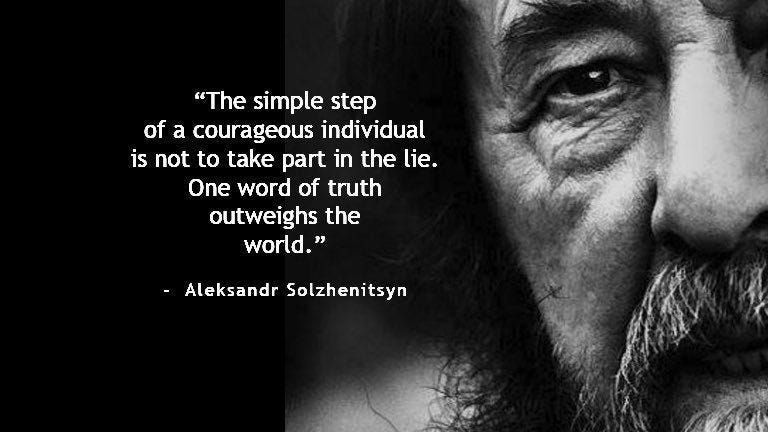
On February 12, 1974—the day of his arrest and the eve of his exile to the West—Aleksandr Solzhenitsyn released this seminal essay (translated by Yermolai Solzhenitsyn, © 2006 English-language copyright), his final message to Soviet citizens before departure. The full text is hosted on the Aleksandr Solzhenitsyn Center's site, introduced as an "immortal" call for civic courage against ideological lies that sustain oppressive regimes by demanding daily personal participation and submission. Solzhenitsyn equates "lies" with the totalitarian ideology that pretends to reshape human nature and society, arguing that the system relies not primarily on violence (which grows old and uncertain) but on enforced falsehoods maintained through individual compliance and fear.



Key points include:
Collective passivity and internalized determinism ("being determines consciousness") enable the regime; guilt lies with ordinary people who participate in lies, not just "they" in power.
The simplest, most accessible path to liberation is personal nonparticipation in lies—"Let their rule hold not through me!"—even for the timid, as refusing to affirm falsehoods detaches the parasite of lies from its host.
A non-exhaustive list of practical refusals includes: not signing, writing, publishing, reading aloud, or depicting lines that distort truth; not citing unshared "guiding" quotes; not attending or joining forced rallies, meetings, or demonstrations against one's beliefs; not voting for unsupported proposals/candidates; walking out of lectures, plays, films, or sessions upon hearing ideological drivel; and avoiding subscription to distorting media.
Though initially costly (e.g., job loss, complications for the young), this path restores spiritual independence and soul integrity; if thousands or tens of thousands join in passive resistance, the regime cannot cope, and transformation becomes inevitable.
Solzhenitsyn concludes with an urgent appeal: "Ours is but to join! ... If we become thousands—they will not cope, they will be unable to touch us. If we will grow to tens of thousands—we will not recognize our country!"
The essay emphasizes that liberation starts individually through small, courageous acts of truth over conformity, offering hope that mass non-cooperation could dismantle the inhuman system without violence. The Center provides the complete text (not excerpted), context from The Solzhenitsyn Reader (Ericson & Mahoney), and links to related resources like blog posts and the book for purchase.
Footnotes Transformed: An AI-Generated Musical Experiment
I fed these footnotes into an AI to transform them into song lyrics. Here’s the musical result—enjoy the zany melody born from betrayal’s berries!
Delaware State Symbols


Delaware designated "Our Delaware" as the official state song in 1925
Lyrics
🎶OUR DELAWARE 🎶
VERSE 1
Oh the hills of dear New Castle,
and the smiling vales between,
When the corn is all in tassel,
And the meadowlands are green;
Where the cattle crop the clover,
And its breath is in the air,
While the sun is shining over
Our beloved Delaware.
CHORUS
Oh our Delaware
Our beloved Delaware!
For the sun is shining over
our beloved Delaware,
Oh our Delaware
Our beloved Delaware!
Here’s the loyal son that pledges,
Faith to good old Delaware.
VERSE 2
Where the wheat fields break and billow,
In the peaceful land of Kent,
Where the toiler seeks his pillow,
With the blessings of content;
Where the bloom that tints the peaches,
Cheeks of merry maidens share,
And the woodland chorus preaches
A rejoiceing Delaware.
VERSE 3
Dear old Sussex visions linger,
Of the holly and the pine,
Of Henlopens Jeweled finger,
Flashing out across the brine;
Of the gardens and the hedges,
And the welcome waiting there,
For the loyal son that pledges
Faith to good old Delaware.
VERSE 4
From New Castle’s rolling meadows,
Through the fair rich fields of Kent,
To the Sussex shores hear echoes,
Of the pledge we now present;
Liberty and Independence,
We will guard with loyal care,
And hold fast to freedom’s presence,
In our home state Delaware.

This is a modern rendition of “Our Delaware” I found by Harrowind (formerly Red Vanguard).
Original video can be viewed here: https://youtu.be/ZKFvWpkNf9Q
What does “Delaware” mean?
The name “Delaware” originates from the Delaware River and Bay, which were named in honor of Sir Thomas West (Lord De La Warr), the first governor of the English colony at Jamestown, Virginia in 1610.
Delaware was the first state to ratify the U.S. Constitution on December 7, 1787 (statehood dates), and since 1933, Delaware’s governors have proclaimed December 7 as “Delaware Day.”
Thank You
for reading Berries of Betrayal.
Additional copies can be purchased here.
© 2026 Schooling Delaware – All rights reserved.
Disclaimer: Berries of Betrayal: Delaware’s Path to Righteous Reform is a work of fiction inspired by real-world events and public records. It is not intended as a factual account, biography, or legal analysis. The sources linked here are provided for adult readers interested in exploring the inspirations behind the story. This page is for informational purposes only and does not constitute legal, political, or professional advice.