
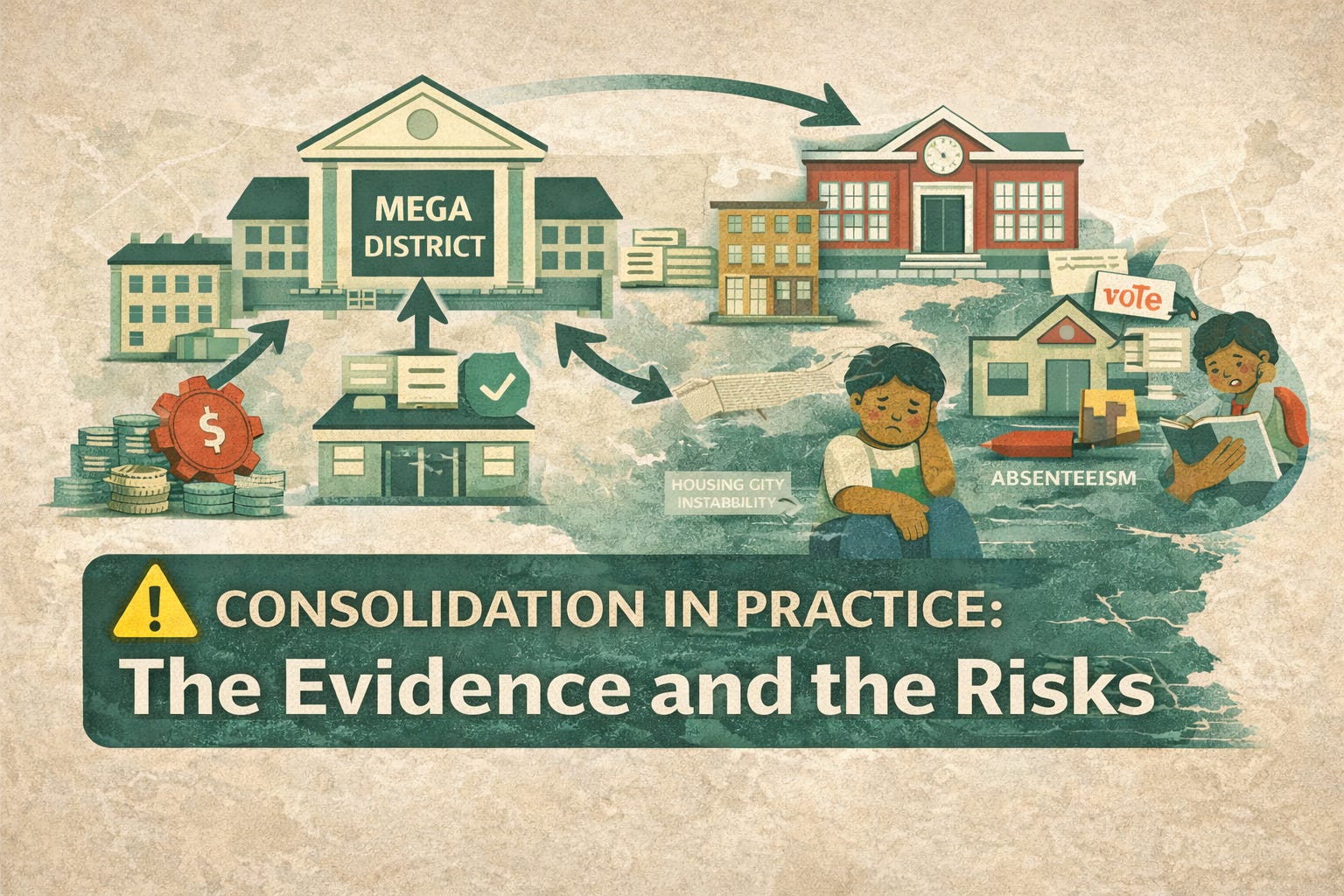

The Redding Consortium has now voted almost unanimously in favor of creating a single consolidated school district for Northern New Castle County, Delaware.
Let’s be very clear — not just for Delaware, but for communities nationwide:
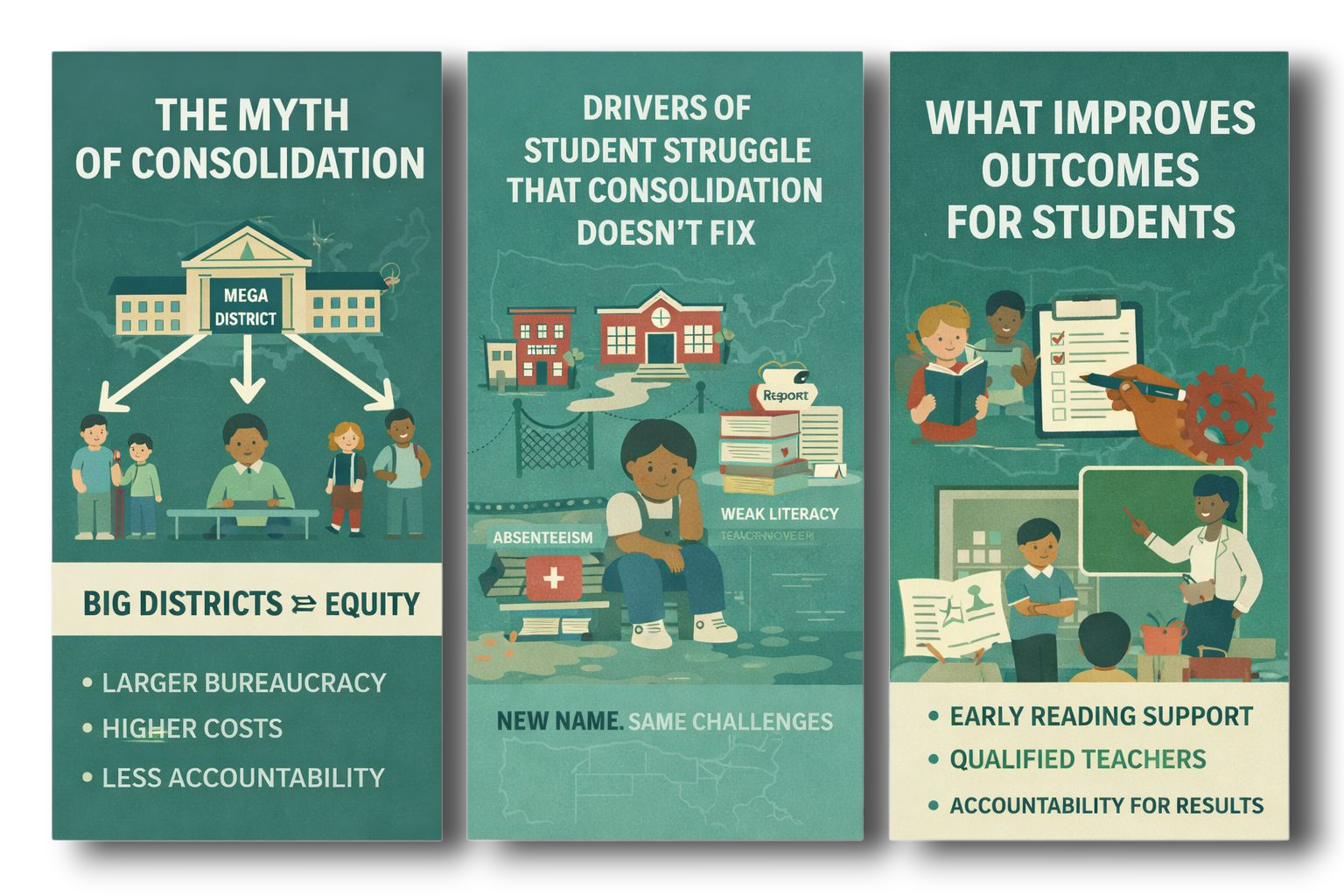
A mega-district is not a solution to the real problems facing students.
It doesn’t fix poverty.
It doesn’t stabilize housing.
It doesn’t improve attendance.
It doesn’t guarantee better teachers, stronger instruction, or higher literacy and math outcomes.
What it does do — reliably and repeatedly — is:
expand bureaucracy,
increase long-term administrative costs,
reduce transparency and accountability,
and shift focus away from what actually happens inside classrooms.
We don’t have to speculate about this.
We already know how consolidation plays out.
🧩 The Myth of Consolidation = Equity
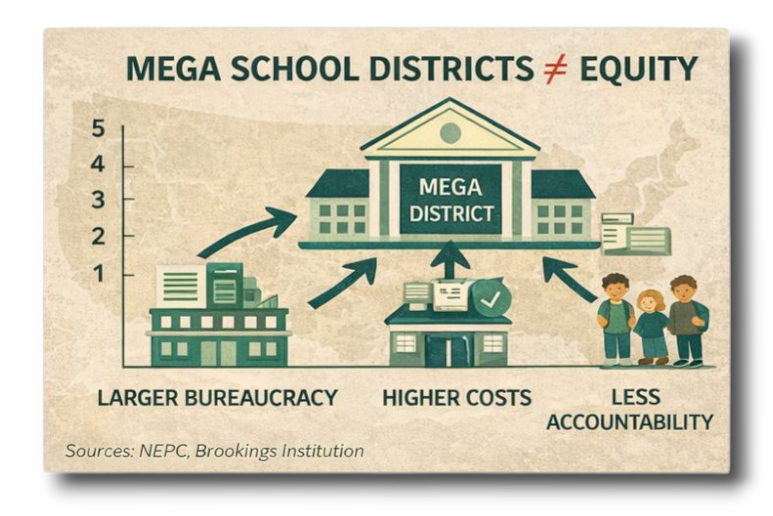
District consolidation is often sold as an “equity” reform.
The theory goes something like this:
Bigger district → shared resources
Shared resources → fairness
Fairness → better outcomes
But decades of evidence show that governance structure is not a substitute for instructional quality.
Children don’t experience equity at the district office. They experience it:
in classrooms,
through curriculum,
with teachers,
through consistent attendance,
and via early intervention.
Those factors don’t improve just because lines on a map change.
📉 What Consolidation Actually Produces
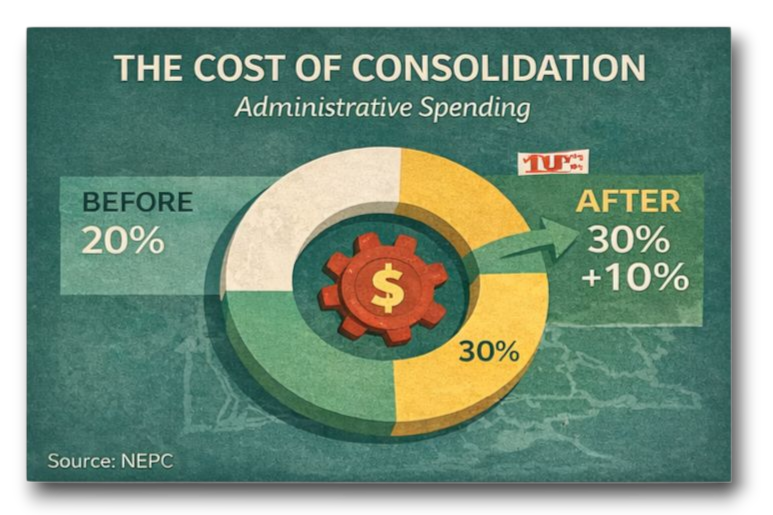
Across the country, district consolidation has consistently resulted in:
Larger central offices
More layers between families and decision-makers
Slower responses to student needs
Less community voice
Higher transportation costs
Budget growth without proportional academic gains
Research Highlights
Across independent research groups — left, right, and nonpartisan — the conclusion is the same: consolidation changes governance charts, not classroom outcomes.
Consolidation Has “Null or Very Small” Impacts on Student Achievement
A study using Arkansas’s mandatory consolidation policy (Act 60) finds that merging districts had no meaningful positive effect on standardized test scores in math and English Language Arts — and did not lead to greater instructional spending.
National Literature Reviews Show No Conclusive Student Benefit
Comprehensive literature reviews consistently find no conclusive evidence that consolidation improves academic performance, even though it is often justified for administrative efficiency. Many analyses also note that student achievement effects are small, inconsistent, or context-dependent.
Policy Briefs Report No Academic Improvement Nationally
Several state education association reports note that studies from around the country have documented no inherent improvement in academic achievement through consolidation, and in some cases consolidation can increase total spending without improving outcomes.
Specific Regional Studies Show Mixed — at Best Minimal — Effects
Various academic and policy studies (e.g., in Mississippi and Michigan metro areas) find no improvement or slight declines in student achievement following consolidation, suggesting it is not a reliable strategy for raising proficiency.
A 2013 independent study at The College of Wooster looked at the effects of school district consolidation in the metropolitan Detroit area. The researchers used multiple estimation techniques and found either negative impacts or no impact at all on student academic achievement following consolidation — suggesting that merging districts doesn’t inherently improve proficiency and may even worsen outcomes.1
🏫 Massachusetts: Proof That Governance Isn’t the Fix
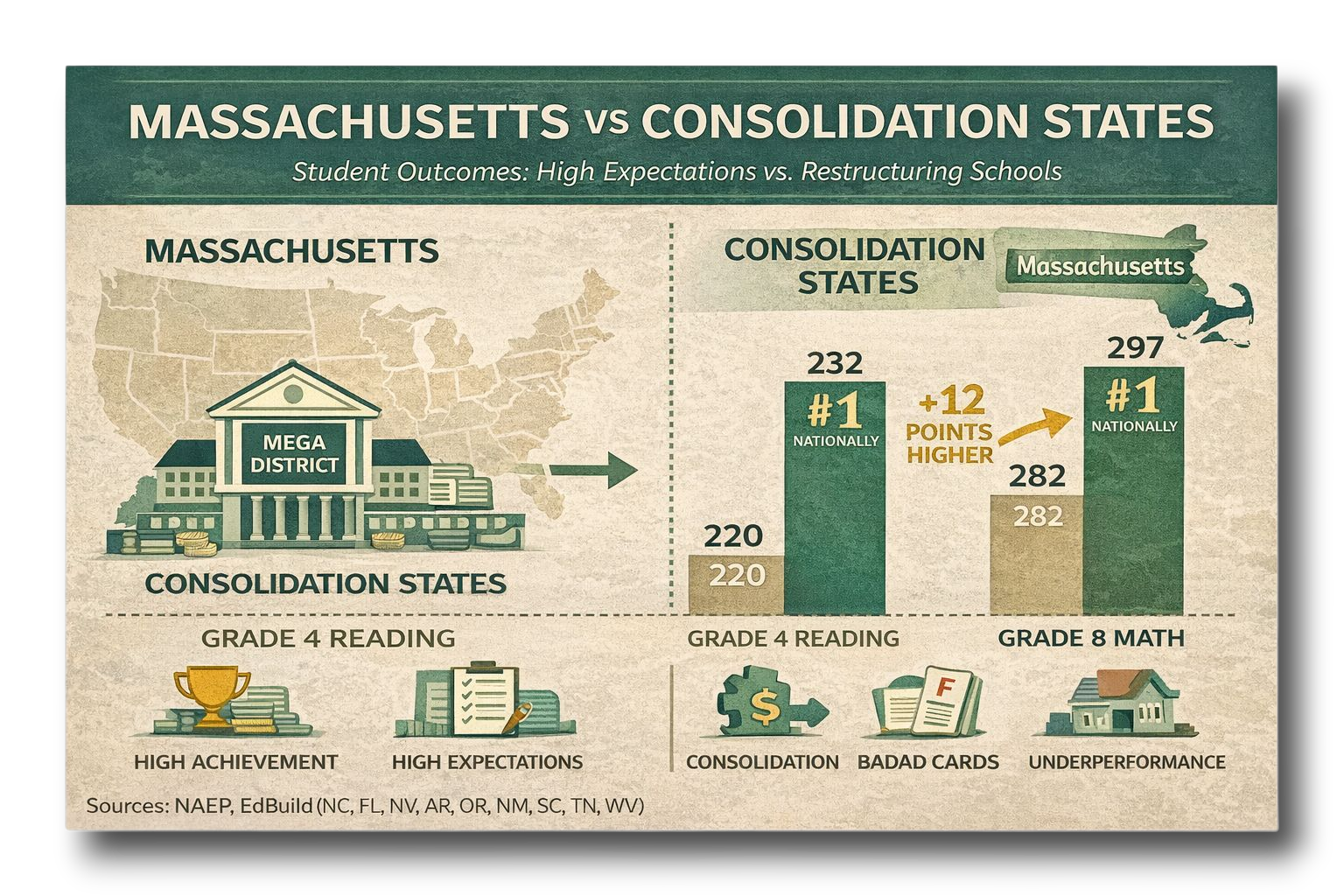
If consolidation were the key to equity, Massachusetts wouldn’t work.
Yet Massachusetts consistently ranks among the top states in:
reading and math achievement,
outcomes for low-income students,
graduation rates,
and postsecondary readiness.
And they didn’t get there by merging districts.
What Massachusetts Actually Did
Focused relentlessly on instructional quality
Implemented evidence-based early literacy statewide
Invested heavily in teacher training and coaching
Used weighted student funding tied to student need
Established clear accountability systems
Intervened directly when schools failed to improve
📌 They fixed what happens inside classrooms, not the governance chart.
Sources:
Massachusetts Ranks #1 in National Education Assessment2
Massachusetts consistently ranks at or near the top of the nation on the National Assessment of Educational Progress (NAEP), the federally administered “Nation’s Report Card.” Most recently, the state ranked first in the nation in math and reading outcomes compared with other states, showing stronger proficiency on average than national peers.
Detailed state NAEP profiles confirm that Massachusetts students score above the national average in both reading and mathematics, underscoring that strong academic outcomes are possible — but they are linked to quality instruction and accountability systems, not simply district boundary structures.
Mississippi Rising
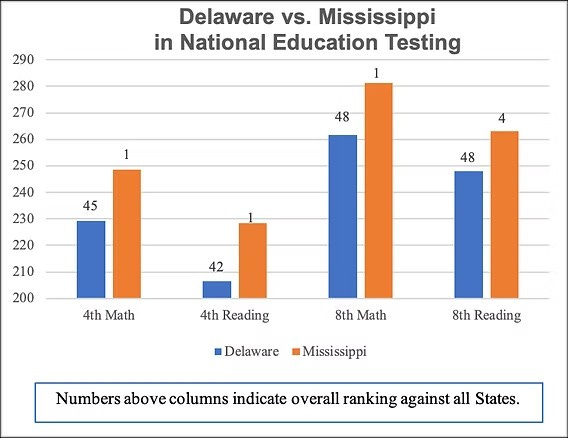
Mississippi's climb results from targeted reforms, high standards, and consistent focus. Delaware's decline suggests a systemic failure to meet modern educational challenges.
Delaware Slipping, Mississippi Rising: A Tale of Two States Changing Places4
May 4, 2025 | Caesar Rodney Institute
Mississippi's education turnaround has not happened by chance. Over the past decade, the state has instituted rigorous early literacy programs, raised expectations for teachers and students, and committed to consistent policy implementation. Meanwhile, Delaware has struggled with ineffective leadership, consistently poor policy and a lack of vision.
Mississippi's rise is not just a feel-good story, it's proof that with clear goals and consistent execution, a state can overcome entrenched challenges. Delaware's decline, on the other hand, is a cautionary tale about the dangers of complacency and refusal to modernize.
What Happens When Consolidation Is Actually Tried: Memphis–Shelby County, Tennessee
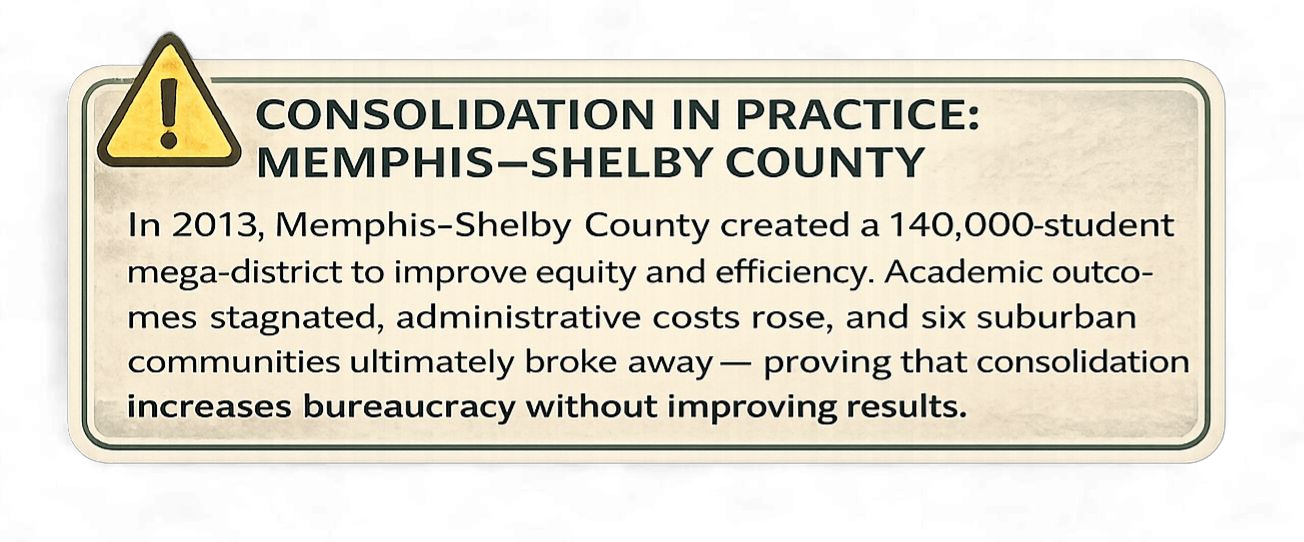
Supporters of consolidation often argue that resistance comes from fear of change — or that “this time will be different.”
But we don’t have to guess.
One of the largest and most recent consolidation experiments in the United States already tested this theory — and it failed!
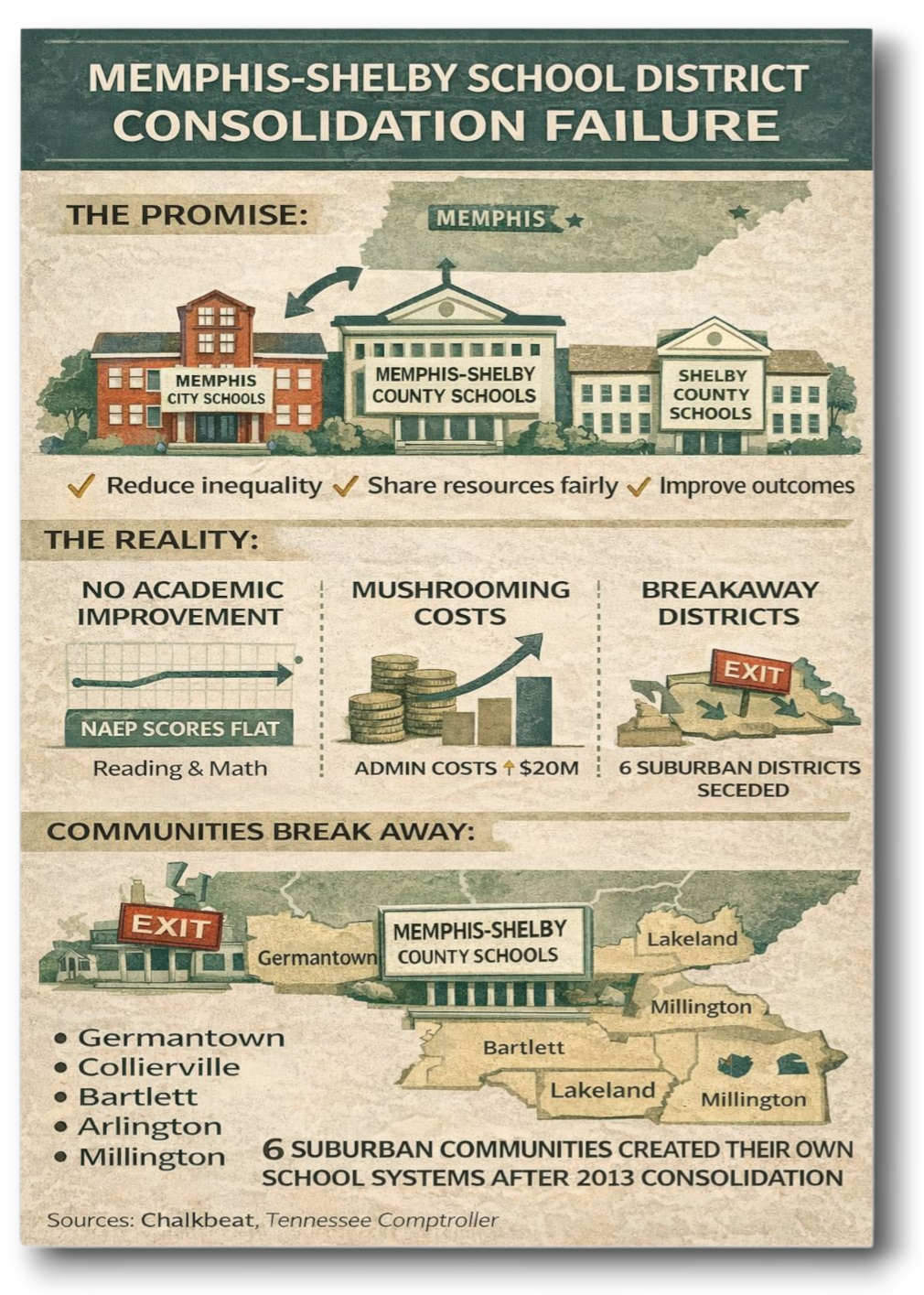
In 2013, Memphis City Schools merged with Shelby County Schools to form Memphis–Shelby County Schools (MSCS), a single mega-district serving more than 140,000 students.
The promises were familiar:
greater equity
shared resources
improved outcomes for low-income students
administrative efficiency
What followed should give any state pause.
📉 Academic Outcomes Stalled
Post-consolidation data showed:
reading and math scores remained flat or declined
achievement gaps persisted
gains that did occur aligned with state-level instructional reforms, not the merger itself
Source :
The Nation’s Report Card (NAEP)5
In other words, instruction mattered — governance size did not.
💸 Administrative Costs Increased, Not Decreased
Instead of streamlining operations, the consolidated district:
expanded its central office
added management layers
increased transportation and logistical costs
failed to deliver the promised efficiencies
Source:
Tennessee Comptroller of the Treasury
👉 https://comptroller.tn.gov/office-functions/research-and-education-accountability.html
This mirrors what national research consistently finds:
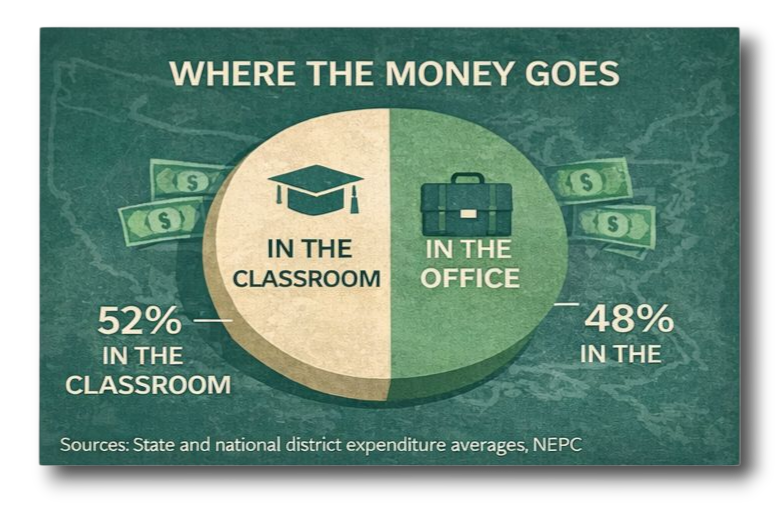
consolidation shifts money away from classrooms and toward administration.
🏘️ Community Trust Collapsed
Perhaps the most telling outcome wasn’t academic or financial — it was civic.
Within just a few years: six suburban municipalities left the district entirely, forming their own school systems:
Germantown
Collierville
Bartlett
Arlington
Lakeland
Millington
Families cited:
loss of local control
slower decision-making
diluted accountability
governance chaos
Source:
Onside the Largest-and Briefest-School District Consolidation in American History6
This study finds that the Memphis–Shelby County consolidation did not improve educational outcomes and that achievement gaps were driven mainly by poverty and student disadvantage, not by district structure. It concludes that consolidation shifted focus to bureaucracy and competition between districts, while resources continued to be allocated by enrollment rather than student need—leaving core inequities unchanged.
The Disintegration of Memphis-Shelby County, Tennessee: School District Secession and Local Control in the 21st Century7
A qualitative research article explores the political and social dynamics after the Memphis–Shelby County merger, including district boundary changes and suburban secession — which reflect how governance shifts don’t necessarily improve equity or outcomes:

Municipal superintendents cite challenges, benefits of split from Shelby County Schools8
Instead of unity, consolidation produced fragmentation.
🎯 Why This Matters for Delaware — and Everywhere Else
The Memphis–Shelby experience exposes the core flaw in consolidation logic:
You cannot govern your way out of instructional failure.
Bigger systems don’t create better teaching.
Central offices don’t close achievement gaps.
Equity language doesn’t replace literacy instruction.
When accountability weakens and bureaucracy grows, communities respond by pulling away — not leaning in.
This isn’t a theoretical warning.
It’s a documented outcome.
🧠 The Real Drivers of Poor Outcomes Don’t Disappear
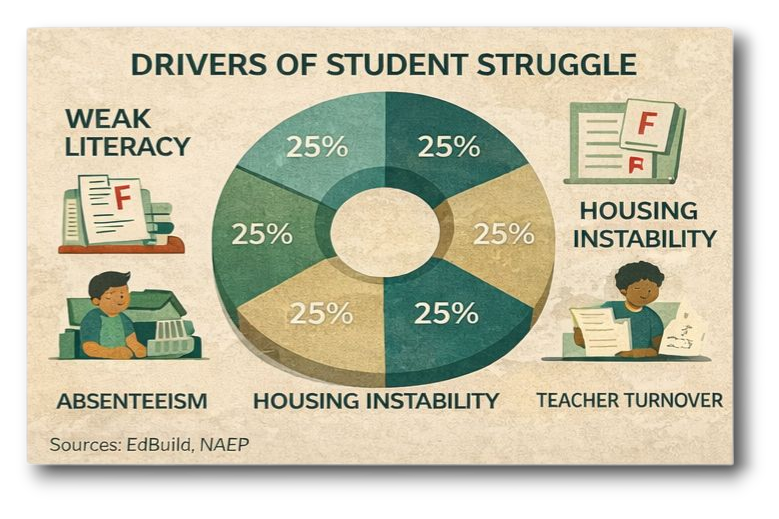
In Delaware — and everywhere else — the core drivers of student struggles are well known:
Poverty and housing instability
Chronic absenteeism
Weak early literacy instruction
High teacher turnover
Inconsistent curriculum
Lack of accountability
Limited family supports
Changing district boundaries does nothing to address these.
These challenges follow children no matter what district name is on the building.
🎭 Political Theater vs. Student Results
What we’re seeing in Delaware is not unique.
Across the country, consolidation proposals often:
rely heavily on equity language,
promise future efficiencies,
avoid concrete academic benchmarks,
and push risk onto taxpayers and families.
Structural change is easier to sell than instructional reform. It looks bold. It sounds decisive. But it avoids the harder work of fixing teaching and learning.
✅ What Actually Helps Students (Anywhere in America)
If leaders are serious about improving outcomes — especially in high-need communities — the evidence is clear.
We should be investing in:
Early literacy screening and tutoring
Science-based reading instruction
Stabilizing teaching staff
Coaching and professional development
Attendance interventions
Family and housing supports
Transparent data reporting
Clear accountability for results
None of that requires a mega-district.
📚 Want to Go Deeper? Recommended Reading & Listening
📖 Books
“The Knowledge Gap” — Natalie Wexler
Why instruction matters more than structure
👉 https://www.nataliewexler.com/the-knowledge-gap“Dumbing Us Down” by John Taylor Gotto
How schools condition, not educate, students
👉 https://www.goodreads.com/book/show/225850.Dumbing_Us_Down“NEA: Trojan Horse In American Education”
by Samuel L. Blumenfeld
How the NEA undermines American education“Indoctrinating Our Children to Death” by Alex Newman
Exposing the agenda shaping modern education
👉 https://westernislandspublishing.com/product/indoctrinating-our-children-to-death/
“When Race Trumps Merit” by Heather Mac Donald
How identity politics undermine merit and excellence“Inside American Education” by Thomas Sowell
The Deterioration of American Schools
🎧 Podcasts
Sold a Story (APM Reports)
How bad instructional theory — not governance — caused literacy failure
👉 https://features.apmreports.org/sold-a-story/Deep End of Public Education (Kristin Grubbs)
Deep dives into education policy mythsMaking the Leap [ended] (Christine and Chris Stigall)
Break free from the status quo
📰 Articles


🎯 The Bottom Line
One district does not equal equity.
Bigger systems do not equal better outcomes.
Governance reform without instructional reform is a distraction.
If we want to help students — in Wilmington, in Delaware, or anywhere in America — we need to stop chasing structural experiments that sound good and start fixing what actually matters:
Teaching. Learning. Accountability. Results.
Our kids deserve solutions that work — not political theater dressed up as reform.